
Build a Post-Fair Verification Brief from China Furniture Exhibition Samples
A practical method for visiting a China furniture fair around use cases, materials, dimensions, construction, packing, supplier roles, and factory follow-up.
A China furniture fair is most useful when it produces structured evidence rather than a collection of attractive product photographs. Before entering the exhibition, organize your visit around the intended use of each product, its material layers, critical dimensions, construction, packing method, supplier role, and required follow-up. This makes products from different booths easier to compare and reduces the risk that visual presentation will override project requirements.
The objective is not to verify a supplier or approve production on the exhibition floor. A displayed item can demonstrate appearance and provide a starting point for inspection, but it does not by itself establish production capability, material consistency, contractual responsibility, packing performance, or project-delivery readiness. Treat booth statements as supplier-stated information until supported by documents, controlled samples, or appropriate verification.
Your main output should be a post-fair verification brief for each shortlisted supplier. It should connect every photograph, measurement, material question, role claim, and next action to a unique sample ID.
Set the buying frame before entering the exhibition
Define each product by use case, not appearance
Create a separate requirement brief for each intended application, such as residential, hospitality, workplace, retail, or outdoor use. Similar-looking furniture may require different materials, structures, finishes, maintenance procedures, or safety considerations depending on where and how it will be used.
For each product, record:
- Intended room or operating environment
- Expected frequency and intensity of use
- Indoor or outdoor exposure
- Moisture, sunlight, temperature, and cleaning exposure
- User profile and relevant safety considerations
- Target service life
- Maintenance and replacement expectations
- Mandatory requirements
- Preferred but negotiable features
Keep mandatory conditions separate from preferences. A visually appealing chair should not advance if its dimensions, cleanability, stability, or construction are unsuitable for the documented use case.
Editorial note: Exhibition presentation demonstrates appearance, not verified performance, repeatability, or production capability.
Establish the dimensions and interface constraints
Bring dimensioned plans, room schedules, access surveys, or product requirement sheets where available. Record the dimensions that determine whether a product can be delivered, installed, operated, and used as intended.
Relevant constraints may include:
- Overall dimensions and acceptable tolerances
- Seat, worktop, shelf, arm, and bed heights
- Doorway, elevator, stair, corridor, and loading-access limits
- Clearance around doors, drawers, recliners, and other moving parts
- Interfaces with walls, floors, utilities, or adjacent furniture
- Modular, knock-down, stacking, or nesting requirements
- Space required for assembly and maintenance
- Alignment requirements across repeated or connected units
Identify dimensions that must be confirmed through a controlled drawing. A tape measurement at a booth may help with triage, but it should not replace an approved dimensioned drawing. Separate dimensions observed on the display sample from dimensions proposed for a customized version.
Prepare a booth triage checklist
Use a short checklist before investing time in detailed discussions:
- Does the product fit a defined use case?
- Are the principal materials identifiable?
- Can relevant construction details be inspected?
- Are critical dimensions available or measurable with permission?
- Is the packing concept suitable for the destination and handling route?
- Has the exhibitor clearly stated its role?
- Is there enough evidence to justify document, sample, or factory follow-up?
- Which details remain unknown?
Avoid requesting or comparing quotations before the product scope and supplier role are sufficiently clear. A price without a controlled specification, inclusion list, and contracting structure may not be comparable.
Capture comparable evidence in a furniture sample log
Inspect materials as a layered specification
Do not record a material simply as “wood,” “leather,” “stone,” or “metal.” Break the product into layers and components, and distinguish among what you can see, what the exhibitor states, and what still requires proof.
For each sample, examine or ask about:
- Surface material and finish
- Substrate or core material
- Frame and internal support materials
- Foam, filling, upholstery, coating, adhesive, and hardware
- Edge treatments, seams, joints, welds, and concealed connections
- Finish color, texture, gloss, pattern direction, and expected variation
- Material substitutions that could affect appearance, durability, maintenance, or price
- Documents, swatches, component samples, or test evidence needed later
A labeled swatch can be more useful than an unlabeled brochure. Link every retained reference to the sample ID, product component, supplier, and date collected. Do not assume that a loose swatch is the material used on the displayed product unless that relationship is confirmed.
Record construction and dimensions without destructive assumptions
Photograph the complete item before taking detail images. Measure only when the exhibitor permits it, and note whether each dimension was measured, supplier-stated, or taken from a drawing.
Inspect accessible joints, fasteners, hardware, seams, edge treatments, welds, upholstery attachment points, removable parts, and undersides. If internal or concealed construction cannot be seen, record it as not observed. Do not infer a frame design, fixing method, substrate, or internal support arrangement from appearance alone.
During follow-up, request relevant drawings, sections, component lists, or evidence from a controlled disassembled sample. Keep displayed dimensions separate from proposed custom dimensions so the two are not accidentally treated as the same specification.
Use the furniture sample log
| Log field | What to record at the fair | Evidence to retain | Follow-up question |
|---|---|---|---|
| Sample ID | A unique code linking notes and photographs | ID card photographed beside the item | Does the code refer to a current specification or only to the display sample? |
| Project use case | Intended room, user group, environment, and duty level | Requirement-sheet reference | What changes would be required for the stated use? |
| Product category | Chair, table, casegood, sofa, bed, workstation, or other type | Full-item photograph | Which components are included or excluded? |
| Dimensions | Measured, stated, or drawing-based dimensions | Permitted tape-measure photograph or supplied drawing | What tolerances apply to critical dimensions? |
| Visible materials | Surface, substrate, frame, filling, fabric, hardware, and finish | Close-up photographs and labeled swatches | Which materials require documentary confirmation? |
| Construction | Observed joints, fasteners, welds, seams, edge treatments, and removable parts | Detail photographs | How are concealed structures assembled? |
| Functional checks | Movement, stability, alignment, access, adjustment, or assembly observations | Short video where permitted | Which checks can be repeated on an approved sample? |
| Finish reference | Color, texture, sheen, pattern direction, and visible variation | Labeled physical sample or color reference | How would an approved finish be controlled in production? |
| Packing concept | Assembled, knock-down, nested, flat-packed, or otherwise stated | Packing image or sketch, if actually displayed | Can a packing drawing and pack-out details be provided? |
| Supplier role claimed | Manufacturer, trader, brand, design company, or project coordinator | Business card and written role statement | Which legal entity manufactures, sells, invoices, and manages follow-up? |
| Open evidence gaps | Anything not visible, documented, or verified | Numbered issue list | What proof is required before shortlisting? |
| Next decision | Reject, hold, request information, request sample, or consider factory verification | Decision owner and rationale | What evidence would change the decision? |
Apply a disciplined photo and file-naming method
Place the sample ID in the first photograph of each product sequence. Then capture, where permitted:
- Full product
- Front, side, and rear views
- Material and finish details
- Joints, seams, hardware, edges, and accessible undersides
- Labels or specification sheets
- Packing examples, but only if they are actually displayed
A file name such as SupplierCode_SampleID_View_DetailNumber helps prevent photographs from different products or booths from becoming mixed. Store verbal statements as attributed notes rather than established facts. For example, write “supplier representative stated that the frame is stainless steel” until supporting material information is received.
Do not photograph restricted areas, and do not present a booth sample as evidence of confirmed production output.
Separate supplier role from product appeal
Ask who performs each commercial and production function
The organization exhibiting a product may manufacture it, source it, own its design, coordinate other suppliers, or perform several of these functions. Ask role-specific questions rather than relying on a general description.
Clarify:
- Who owns or controls the product design and specification?
- Who manufactures the displayed item?
- Which components or processes are subcontracted?
- Which legal entity would issue the quotation, contract, and invoice?
- Who would produce drawings, samples, material submissions, and packing information?
- Who would coordinate multiple furniture categories?
- Who would respond to quality issues?
- Which facility could be considered for later verification?
- Does the role change by product category?
Treat each answer as a claim requiring written and documentary follow-up.
Build the supplier-role comparison table
| Possible role | What the exhibitor may handle | Evidence to request after the fair | Buyer implication to assess |
|---|---|---|---|
| Manufacturer | Production of some or all offered products | Legal entity details, facility address, process list, sample records, and permission for verification | Whether the relevant product and processes are actually handled at the stated facility |
| Trading company | Supplier search, commercial coordination, and consolidation | Named manufacturing sources, responsibility matrix, inspection access, and invoicing entity | Visibility into subcontracting, changes, quality responsibility, and communication flow |
| Brand or product company | Design, merchandising, specification, and sales | Product ownership statement, production arrangement, approval process, and warranty terms | Whether the offer is a repeatable branded product or suitable for a custom requirement |
| Design studio | Concept, drawings, material selection, or customization | Design scope, technical deliverables, revision process, and manufacturing partners | Where design responsibility ends and manufacturing responsibility begins |
| Project coordinator or integrator | Coordination across categories, suppliers, schedules, or installation parties | Written scope, named parties, milestone responsibilities, and escalation route | Whether coordination provides useful control or obscures direct accountability |
| Mixed-role organization | A combination of manufacturing, trading, design, or coordination | Entity chart and product-by-product responsibility map | Whether the role changes across products or project stages |
Score role clarity separately from sample quality
Evaluate the product and the supplier structure using separate ratings:
- Product relevance
- Material evidence
- Construction evidence
- Dimensional fit
- Packing readiness
- Supplier-role clarity
- Factory-verification feasibility
- Project-coordination scope
A strong display sample should not compensate for an unclear contracting, invoicing, or manufacturing structure. Use unknown when evidence is missing instead of assigning a favorable score based on an unsupported statement.
Convert fair observations into factory and project follow-up
Request evidence in a controlled sequence
After the fair, structure communication around the sample IDs rather than sending a general request for information:
- Send the relevant sample IDs and photographs so both parties confirm which products are under discussion.
- Request specifications, dimensioned drawings, material breakdowns, and finish references.
- Ask which legal entity and proposed facility would be responsible for each product.
- Clarify responsibility for customization, drawings, samples, approvals, revisions, and change control.
- Request a product-specific packing proposal.
- Review the evidence before choosing a controlled sample, remote review, third-party check, or product-specific factory visit.
- Keep lead times, capacity statements, compliance claims, and delivery outcomes marked as unverified until adequately supported.
This sequence prevents factory follow-up from becoming a generic facility tour disconnected from the products seen at the exhibition. The purpose is to investigate whether the relevant entity, facility, processes, records, and controls correspond to the shortlisted product.
Review packing as part of product engineering
Packing affects dimensions, handling, assembly, finish protection, site access, and product identification. Confirm whether the proposed item would be shipped assembled, knock-down, nested, stacked, flat-packed, or modular.
Request:
- Packed dimensions and weight
- Carton and internal-protection concept
- Hardware containment and labeling
- Assembly instructions
- Protection for edges, finishes, glass, stone, upholstery, and projecting parts
- Handling orientation
- Unit, room, or package identification
- Pack-out drawings or photographs where relevant
Compare the proposed pack with doorway and elevator limits, warehousing arrangements, manual-handling constraints, final-room assembly, and mixed-item identification. A verbal packing description is not an approved pack-out.
Map responsibilities across project delivery
| Project stage | Decision or evidence needed | Party to identify | Status options |
|---|---|---|---|
| Specification | Approved materials, dimensions, construction, and finish | Buyer, designer, supplier, or shared owner | Open / Submitted / Revised / Approved |
| Drawing review | Shop drawings and interface details | Named drawing producer and approver | Open / Submitted / Revised / Approved |
| Sample approval | Reference sample and permitted deviations | Sample maker and approval owner | Not requested / In progress / Approved |
| Production | Facility and process responsibility | Manufacturer and any subcontractors | Unverified / Partly verified / Verified |
| Quality control | Checkpoints, records, and release authority | Supplier, buyer, or inspection party | Undefined / Proposed / Agreed |
| Packing | Pack design, labels, instructions, and approval | Packing designer and pack-out facility | Undefined / Proposed / Tested / Approved |
| Consolidation | Product receipt, counting, storage, and load coordination | Named coordinating entity | Not applicable / Unclear / Assigned |
| Site handoff | Delivery boundary, assembly, installation, and issue reporting | Named local and supplier-side parties | Unclear / Assigned / Documented |
| Defect response | Evidence, decision authority, remedy, and escalation route | Contracting entity and responsible producer | Undefined / Proposed / Agreed |
This responsibility map does not confirm that any party will achieve a particular outcome. Its purpose is to expose unclear ownership before the buyer relies on assumptions about drawings, approvals, quality control, packing, or site handoff.
Create a shortlist gate before factory follow-up
Advance a supplier only when:
- The product matches a documented use case.
- Critical dimensions are known or can be confirmed through drawings.
- Material and construction evidence gaps have been listed.
- The supplier’s claimed role is recorded in writing.
- The proposed manufacturing facility is identified for the relevant product.
- Packing questions are included in the follow-up scope.
- Responsibility for drawings, samples, approvals, changes, and issue resolution is visible.
- No delivery statement is treated as verified merely because it was made at the exhibition.
A supplier does not need every issue resolved at the fair. It does need a clear evidence path showing what must be confirmed, by whom, and before which decision.
Image gallery
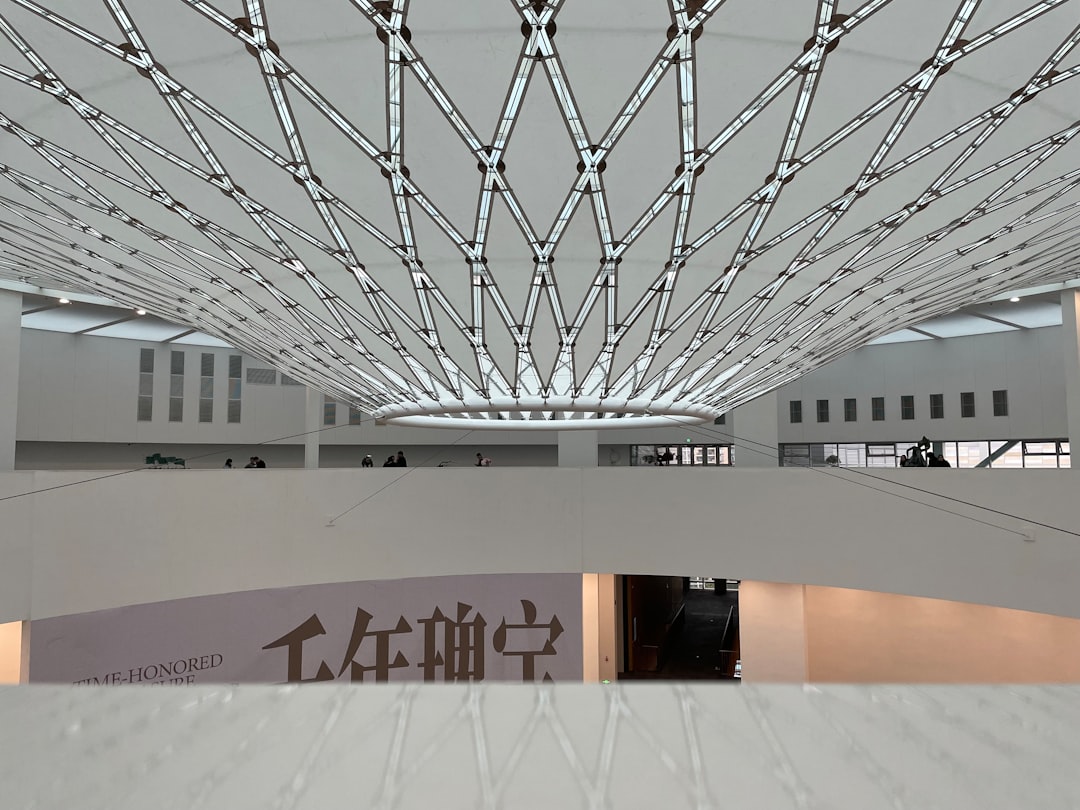
A large exhibition interior can make systematic navigation and sample identification as important as visual product discovery.
Photo by Diosming on Unsplash. Licensed under the Unsplash License.
Final next move
Produce one verification brief for each shortlisted supplier
Attach the completed furniture sample log and group all photographs by sample ID. Add the supplier-role comparison, identify unresolved role questions, and list missing drawings, specifications, material evidence, construction details, and packing information.
Assign every open point to a named party and classify each statement as:
- Observed
- Supplier-stated
- Documented
- Independently verified
- Still unknown
Then select one controlled next action for each supplier: close the lead, request documents, request a controlled sample, arrange remote verification, or prepare a product-specific factory visit. This turns exhibition discovery into an evidence-based sourcing process without treating booth presentation or verbal statements as verified project-delivery capability.
Sourcing information earns its value when it is verified, compared and turned into a decision.