
How to Visit a China Furniture Fair: Evaluate Materials, Suppliers, and Project Delivery
A practical framework for organizing a China furniture-fair visit around use cases, materials, dimensions, construction, packing, supplier roles, and factory follow-up.
A furniture fair can compress months of product research into a few days—but only when the visit is organized around project requirements rather than visual impressions. Buyers, designers, contractors, and sourcing teams should arrive with defined use cases, critical dimensions, material expectations, construction questions, packing assumptions, and a method for recording evidence.
The objective is not simply to find attractive furniture. It is to determine whether a product concept fits its intended environment, what must be verified after the fair, which organization would perform each supplier role, and how information will move into drawings, samples, factory review, production controls, packing, and receiving.
Always confirm current event dates, admission rules, locations, and exhibitor information through official fair channels. A polished booth or well-finished display sample does not, by itself, establish manufacturing capability, production consistency, capacity, compliance, or delivery performance.
1. Build the Visit Plan Around Product Use Cases
Define the project before selecting booths
Divide the sourcing scope by where and how the furniture will be used:
- Residential: living rooms, dining rooms, bedrooms, storage, and outdoor areas.
- Hospitality: guest rooms, lobbies, restaurants, bars, and public areas.
- Workplace: workstations, meeting rooms, lounges, reception, and storage.
- Retail: display fixtures, counters, shelving, seating, and back-of-house storage.
- Build-to-rent or multifamily: repeatable packages, replacement parts, and installation constraints.
For every category, record expected traffic, cleaning methods, indoor or outdoor exposure, humidity, coastal conditions, and installation interfaces. Identify any applicable fire, accessibility, safety, or destination-market requirements that need confirmation. Also distinguish loose furniture from fixed furniture, millwork, and mixed packages because each can require a different supplier and approval process.
Separate the specification into three levels:
- Must have: non-negotiable dimensions, materials, performance, or compliance.
- Preferred: styling, finish, hardware brand, or optional features.
- Open to proposal: areas where a supplier may offer an alternative for review.
Create a category-based route
Instead of walking every aisle without a filter, organize the visit in this order:
- Priority products with unresolved technical requirements.
- Material and component specialists.
- Manufacturers or brands showing relevant construction.
- Traders or integrators that may coordinate mixed categories.
- Backup suppliers and alternative materials.
Assign clear team responsibilities. A commercial lead can address quotation structure, minimum quantities, and payment terms. A technical lead should inspect materials, dimensions, tolerances, and construction. A design lead can review appearance, finish, color, and comfort. A documentation lead should maintain sample records, photographs, contacts, and next actions.
Prepare a one-page product brief
Use one brief for each product family.
| Field | What to prepare before the fair |
|---|---|
| Product use case | Room, user, traffic level, and indoor or outdoor conditions |
| Target quantity | Initial estimate and possible repeat volume |
| Dimensions | Overall size, clearances, interfaces, and ergonomic requirements |
| Materials | Substrate, surface, upholstery, foam, metal, stone, glass, or components |
| Construction | Frame, joinery, edges, hardware, and removable parts |
| Finish | Color reference, sheen, texture, and protective coating |
| Performance | Stability, load, abrasion, moisture, cleaning, or other project criteria |
| Packing | Assembled or flat-pack, carton limits, protection, and labeling |
| Compliance | Destination-market requirements that must be confirmed |
| Delivery context | Sequence, consolidation, access, and installation interfaces |
| Evidence requested | Drawings, specifications, samples, reports, and factory information |
2. Inspect Furniture From Materials Through Packing
Examine materials beyond the visible finish
Ask for the complete material build-up, not only the decorative surface. For wood and panel products, record the solid-wood species or engineered-board type, veneer species and approximate thickness, panel thickness, edge treatment, moisture-control approach, and finish system. Check whether concealed surfaces use different materials.
For upholstered products, ask about the frame, reinforcement, suspension, foam specification, fabric or leather composition, seams, piping, zippers, and removable covers. For metal, stone, glass, and composite components, document the commercial material description, section thickness, welding or edge-finishing method, coating, natural variation, and repair limitations.
Treat verbal descriptions as preliminary. Material statements should remain marked as pending until supported by specifications, labeled samples, reports, or other suitable documentation.
Measure dimensions and interfaces
Bring a tape measure, notebook, reference scale for photographs, and—where permitted—a compact laser measure and caliper. Record:
- Overall width, depth, and height.
- Seat height and depth, back angle, arm height, and clearances.
- Tabletop thickness, leg spacing, and underside clearance.
- Door, drawer, shelf, and internal storage dimensions.
- Knock-down component sizes and assembly access.
- Wall, floor, electrical, cable-management, and adjoining-item interfaces.
Clarify whether a measurement belongs to a standard product, the displayed booth sample, or a proposed customization requiring engineering review. Request dimensioned drawings rather than assuming that a display sample defines future production.
Check construction systematically
Inspect visible and concealed areas where access is allowed, including undersides, backs, drawer boxes, runners, hinges, leg connections, upholstery seams, welds, fasteners, and reinforcement points.
Issues such as uneven gaps, rocking, frame movement, exposed fasteners, finish inconsistency, drawer interference, sharp edges, or weak knock-down connections should be recorded for follow-up. Classify each observation as a possible design issue, a booth-sample workmanship issue, or a production-control question. One display sample cannot demonstrate repeatable mass-production quality.
Discuss packing before final delivery
Packing is part of product engineering because it affects damage exposure, freight utilization, handling, assembly, labeling, and site installation. Ask whether the product is normally shipped fully assembled, semi-knock-down, or flat-pack. Request preliminary packed dimensions and gross weight, while noting that these figures require confirmation.
Review whether:
- Fragile components are removable.
- Hardware is bagged, labeled, and secured.
- Surfaces, corners, edges, and moisture-sensitive areas are protected.
- Assembly instructions are included.
- Cartons can carry project, room, unit, and item codes.
- Replacement parts can be packed and identified separately.
Use a booth inspection checklist
- The product use case matches the project.
- Main and concealed materials are identified.
- Critical dimensions are measured or requested.
- Construction and hardware are photographed with permission.
- Finish references are recorded under consistent lighting where possible.
- Comfort and stability are assessed where relevant.
- Packing method, packed dimensions, and weight are discussed.
- Customization limits are clarified.
- The supplier’s role is identified.
- Missing evidence and documents are listed.
- The next action, owner, and follow-up window are recorded.
3. Log Samples and Classify Each Supplier’s Role
Maintain a furniture sample log
Give every product a unique code before collecting photographs, quotations, drawings, finish samples, or contact details. Use the same code across every file. With permission, photograph the company or booth identifier separately from the product so that records do not become detached from their source.
Do not rely on memory or uncategorized business cards. Complete the log immediately after each meeting while technical details and unresolved questions are still clear.
Furniture sample log
| Sample ID | Use case and product | Supplier | Supplier role | Materials and finish | Key dimensions | Construction notes | Packing notes | Evidence needed | Open questions | Next action and owner |
|---|---|---|---|---|---|---|---|---|---|---|
| CH-CHAIR-01 | Restaurant dining chair | Record legal company name | To verify | Frame, upholstery, coating | Overall and seat dimensions | Joinery, glides, reinforcement | Assembly format and carton details pending | Drawing, material specification, relevant test information | Custom finish? Replacement glides? | Buyer to send brief |
| CH-TABLE-02 | Guest-room desk | Record legal company name | To verify | Panel, veneer, metal hardware | Overall size and wall clearance | Edges, drawer, cable management | Corner and surface protection pending | Drawing, hardware list, packing proposal | Can dimensions change without redesign? | Technical lead to issue mark-up |
| Project entry |
Compare supplier roles before requesting quotations
| Supplier role | Typical contribution | Potential fit | Questions to verify | Main follow-up risk |
|---|---|---|---|---|
| Manufacturer | Produces defined furniture categories | Repeat items requiring technical control and factory access | Which processes are in-house? What is subcontracted? Who controls engineering and quality? | Assuming every displayed product is made in the same facility |
| Brand or design-led supplier | Provides a collection, design language, and product specification | Projects using established products with limited changes | What can be customized? Who manufactures the product? What documentation is available? | Treating an established range as fully customizable |
| Trading company | Sources from multiple factories and coordinates commercial activity | Mixed-category orders needing one commercial contact | Which factory makes each item? Can factory information be shared? How is quality controlled? | Limited visibility into subcontracting and corrective action |
| Export agent | Represents factories and supports export transactions | Buyers that understand the products but need coordination | What decisions can the agent make? Who approves technical changes and resolves quality issues? | Unclear responsibility between the agent and factory |
| Project furniture integrator | Coordinates categories, customization, documentation, and interfaces | Hospitality, residential, workplace, or retail packages | Who controls drawings, samples, consolidation, revisions, and issue tracking? | Assuming coordination ability without reviewing actual systems |
| Material or component specialist | Supplies fabric, leather, foam, hardware, panels, finishes, or mechanisms | Products whose performance depends on specified components | Can the component be supplied to the selected factory? How is traceability maintained? | Approving a component without controlling its use in production |
Ask role-specific questions
For a manufacturer, ask which product families are produced regularly, which operations are completed in-house, who prepares shop drawings and bills of materials, and how approved samples become production instructions. Ask how incoming materials, work in progress, and finished goods are checked.
For a trader, agent, or integrator, identify the proposed manufacturer for each category. Clarify who controls drawings, samples, inspections, packing, consolidation, and corrective actions. Determine who remains responsible when commercial and technical instructions conflict.
For every candidate, record the legal company name, proposed contracting entity, and contacts for commercial, technical, and quality matters. Ask what information is needed to prepare a reliable quotation. Keep unsupported answers marked pending.
4. Convert Fair Findings Into Factory Follow-Up and a Delivery Plan
Shortlist with evidence, not booth appearance
Apply the same assessment to every candidate:
| Evaluation area | Review question | Status |
|---|---|---|
| Use-case fit | Does the product suit the intended users and environment? | Confirmed / Pending / Not suitable |
| Material clarity | Are visible and concealed materials documented? | Confirmed / Pending / Not suitable |
| Dimension control | Are drawings, tolerances, and interfaces available? | Confirmed / Pending / Not suitable |
| Construction | Is the proposed construction appropriate and reviewable? | Confirmed / Pending / Not suitable |
| Packing | Is there an item-specific packing proposal? | Confirmed / Pending / Not suitable |
| Supplier role | Are the manufacturer and responsibility chain clear? | Confirmed / Pending / Not suitable |
| Quality system | Can inspection and corrective-action processes be explained? | Confirmed / Pending / Not suitable |
| Project coordination | Can item codes, revisions, samples, and approvals be tracked? | Confirmed / Pending / Not suitable |
| Commercial fit | Are quotation scope, assumptions, exclusions, and constraints clear? | Confirmed / Pending / Not suitable |
Send a structured request for quotation
A post-fair request should include:
- Product and project reference codes.
- Quantities by item.
- Dimensioned drawings or marked-up reference images.
- Material and finish schedules.
- Construction and hardware requirements.
- Required samples or mock-ups.
- Packing and labeling requirements.
- Destination and shipping assumptions required for costing.
- Documentation and compliance questions.
- Requested breakdowns for unit price, development, samples, packing, and options.
- A clear request for exclusions, assumptions, alternatives, and unresolved points.
Do not allow an alternative material or construction method to be treated as equivalent without review. Suppliers should identify proposed substitutions rather than incorporating them silently.
Plan factory verification
Verify the relationship between the booth entity, proposed contracting company, and factory. A factory review may examine relevant processes, material identification, engineering control, approved-sample management, inspection records, nonconformance handling, packing, and finished-goods storage.
Choose review samples that represent the project’s actual complexity. A simple standard chair may not demonstrate the systems required for mixed-material casegoods, upholstered items, stone tops, integrated lighting, or multi-factory packages. A factory visit documents current observations; it is not proof of future performance.
Build the project control sequence
- Issue the product brief.
- Review supplier assumptions.
- Align quotation scope and exclusions.
- Review drawings, materials, and hardware.
- Evaluate samples or mock-ups.
- Record and approve revisions.
- Establish the pre-production reference.
- Define production checkpoints.
- Review or test packing where appropriate.
- Agree on the inspection scope.
- Check shipping documents and item labels.
- Prepare receiving, installation, snagging, and replacement-part processes.
This is a control framework, not a delivery guarantee. Schedules and outcomes depend on confirmed scope, approvals, material availability, production capacity, inspection findings, logistics, and site readiness.
Image gallery
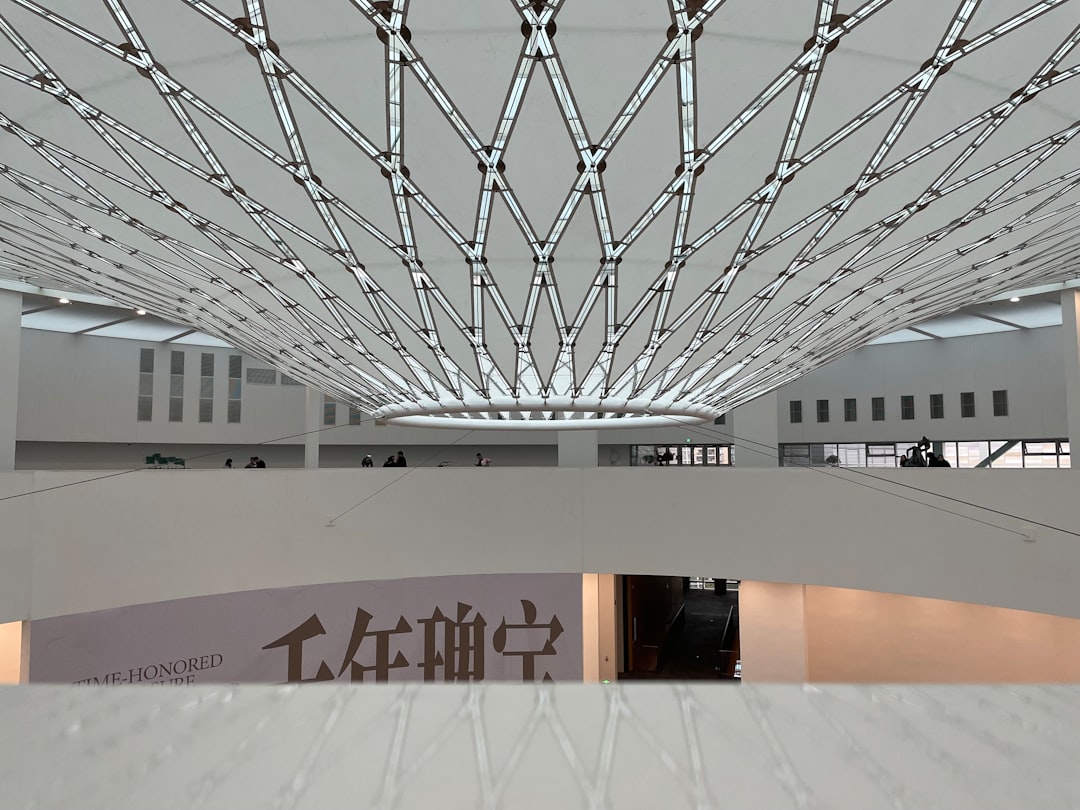
An exhibition interior may be visually impressive, but sourcing decisions should rest on documented materials, dimensions, construction, packing, and supplier responsibilities.
Photo by Diosming on Unsplash. Used under the Unsplash License.
Final Next Move
Create the fair-ready sourcing pack
Prepare one digital or printed folder containing:
- Product briefs organized by use case.
- Material and dimension requirements.
- The booth inspection checklist.
- The furniture sample log.
- The supplier-role comparison table.
- A standard question list.
- A photograph naming convention.
- A structured request-for-quotation template.
Assign a unique code to every product before the visit. After each meeting, reserve a few minutes to complete the log and identify the next action. During follow-up, classify every lead as reject, keep for reference, request information, request quotation, request sample, or consider for factory verification.
Immediate action: Choose one priority furniture package and define its use case, material specification, critical dimensions, construction requirements, packing assumptions, and preferred supplier role before reviewing any exhibitors.
Sourcing information earns its value when it is verified, compared and turned into a decision.